An interesting question raised in class today was the idea of whether a piece of art can become site-specific. While looking at Chapter 10: "Good" Versus "Bad" Objecthood: James Welling, Bernd and Hilla Becher, Jeff Wall in Why Photography Matters as Art as Never Before, Fried considers the idea of an object being "grounded." He writes: "The idea seems to be to eliminate any and all surplus of information about the exact circumstances, physical and other, in which a given object is embedded but at the same time to leave no doubt that the object in question, as the Bechers put it, is not moveable like a cup or a sewing machine but rather is 'strictly connected to the ground'".
The examples of the Statue of Liberty, the triangles outside the Louvre, and the Eiffel Tower were given as pieces that, through history, have become so grounded in their sites that it's difficult to imagine the place without them. Can sites such as these truly be considered site-specific? If not, how do we categorize them?
Wednesday, March 31, 2010

Tuesday, March 30, 2010
Vanishing Point (2008): Award-winning site-specific choreography

As previously discussed, site-specificity has become prevalent in dance performances in recent years, especially in major cosmopolitan areas such as New York City and Hong Kong. In 2008, Tom Pearson and Zach Morris presented their evening-length dance piece, Vanishing Point, as part of the City/Dans series in New York City. In this piece, the dancers and choreographers utilize the beautiful architectural structure of St. Mark's Church to create a stirring example of site-specific dance choreography. The white columns of the church are simultaneously evocative of both a sanctuary and the old rural south. The performance, depicting a fictional funeral at the altar of the church, explores familial relationships that have been complicated by secrets, lies, and liquor. The New Yorker described the piece as "musings on mortality and heritage, innapropriate revelations, repeated runs smack into the altar wall, and dance segments that are touching and deep [that] add up to a vague sense of of Faulkernian doom, set to good music." This award-winning piece is only one example of site-specific dance choreography performed and created by the dance group Third Rail Projects.
Monday, March 29, 2010
Jochen Gerz & Esther Shalev-Gerz's "Monument Against Fascism"
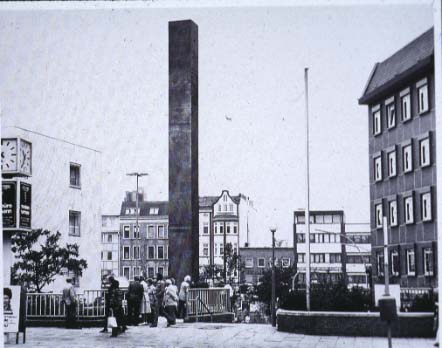
In 1986, a monument called the "Monument Against Fascism, War and Violence -- and for Peace and Human Rights" was constructed in Hamburg, Germany. Two artists, Jochen Gerz and Esther Shalev-Gerz,designed a structure which has come to be called a countermonument. (Countermonuments tend to criticize traditional monuments by stating that a monument can only do so much and that it is the people who must take a stand.) Once their design was approved, the city wanted to place the monument in a park, however, Gerz and Shalev-Gerz chose instead to place their piece in a busy shopping center. Their design was by no means aesthetically pleasing but their purpose in designing this monument was to raise awareness. Due to its placement, the monument was noticed by many, catching many an eye. In addition to its ugly design, the artists intended for it to contrast its surroundings and hung pens from each corner of the 12-meter tall pillar, inviting people to sign their names on it. An inscription at its base read "We invite the citizens of Hamburg and visitors to the town, to add their names here to ours. In doing so, we commit ourselves to remain vigilant. As more and more names cover this 12 meter tall lead column, it will gradually be lowered into the ground. One day it will have disappeared completely, and the site of the Hamburg monument against fascism will be empty. In the end, it is only we ourselves who can rise up against injustice." The monument was eventually lowered entirely into the ground in 1993, sealed into the ground by a piece of glass through which people can still see the top of the column. Though the monument itself is not as easily visible as it was when first erected, its location in the middle of the busy shopping center reminds passers-by of its significance.
The original monument:

What can be seen today of the monument:

Questions to consider:
-Can all monuments be considered site-specific?
-If the artist intends for the piece to eventually disappear, is that considered "destroying the work"? (Remember Richard Serra's quote: "To move the work is to destroy the work".)
The original monument:
What can be seen today of the monument:

Questions to consider:
-Can all monuments be considered site-specific?
-If the artist intends for the piece to eventually disappear, is that considered "destroying the work"? (Remember Richard Serra's quote: "To move the work is to destroy the work".)
Wednesday, March 24, 2010
Grace and Composure
Today's in-class discussion of Fried's Why Photography Matters began with a focus on the work of French photographer Roland Barthes. Barthes exhibits concepts known as punctum and studium. The latter refers simply to the content of a photo, while the former focuses more on the effect a photo has. Being a belletrist, i.e. one who places importance on aesthetics, Barthe often muses on his photos with an air of intuition, rather than education. Indeed, many true works of art, or photography, possess a certain "greatness" that is often unable to be truly explained. Stemming from the works of Barthe, and the aforementioned concepts, the discussion shifted to the ideas of aesthetics in photography, named grace and composure. Many photos, while appearing to come off as natural, may in reality be quite contrived. Several photos were shown, with many proving to be quite revealing in their intentions. As the topic of grace was brought up, a specific importance to the human body seemed to arise. The idea of grace, or gracefulness, generally refers to a certain elegance and relative ease with which a body (or object) interacts with its environment. Similarly, the concept of composure highlights a certain harmony between the movements of the body, in relation to the surroundings as well.
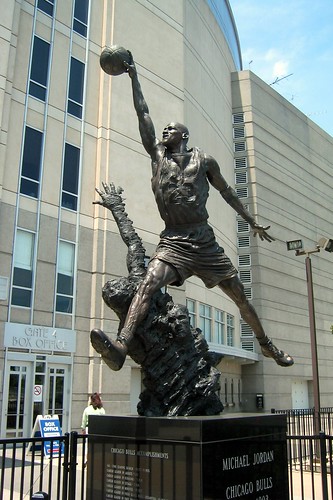
As the discussion of grace and composure moved forward, the idea that came first into my head was that of an athlete on his/her competitive field. To witness such a great physical specimen display such unique and awe-inspiring body control, as well as control over, say, a ball, is perhaps one of the truest forms of grace. This spark of inspiration, combined with the dovetailing concepts aforementioned got me thinking of how they might be essential to the idea of site-specific art. Indeed, one of the basic underlying concepts of site-specific art is the piece's relationship with its environment, or, one might argue, the grace with which it exists harmoniously with all aspects of its habitat. To combine the world of athletics with that of site-specific art is no easy task, however I was able to find an excellent example in the form of the iconic Michael Jordan. Playing with the Chicago Bulls for his entire career, MJ won 6 NBA championships and set innumerable records en route to becoming the greatest basketball player of all time. To pay homage, the City of Chicago erected a bronze statue of His Airness outside of the United Center, where the Bulls play their home games. Displaying Jordan flying through the air, in the same pose seen on the Air Jordan line of Nike products, the statue is a truly graceful representation of a player who played the game of basketball more beautifully than perhaps anyone in history. The fact that it stands tall on the outskirts of the arena, in the heart of the city in which Jordan forged his legacy, makes it a truly site-specific work, as well as an aesthetic and masterful representation of the high-flying sport of basketball.
Studium, Punctum, & Roland Barthes

Roland Barthes retains a sense of profundity in his work. His ideas of transforming everyday things into true science, the punctum & the studium, and his criticism in general have had great impact on the world of modern art and criticism. Focusing on the punctum and studium, today I will look at its relation to the situation.
As noted, images will outlast their producers. That being known, it is interesting to see that situation, something that is so dynamic, can be captured in film. We can look at any given photo and without hesitation point out that there is a situation, whether manufactured or natural; that is, the difference between theatricality and absorption. Going back to my own photos, there is a distinct punctum that is quite irritating in almost every picture. The absorption that is associated with candidness is something I firmly believe comprises any punctum. Looking at Nicaragua, I see that the punctum is a product of the situation itself. If the nuns were not walking one way, the soldiers another, there would be no situation (of course depending on your standards for a situation), hence no punctum. It is, as I see it very difficult to have art devoid of a punctum, for almost everything creates some sort of tension, even if it’s the aesthetics of the thing that please you in the first place.
This is not to say the punctum is limited to the realms of photography, for its applications extend far beyond. Let us look at Chris Burden’s performance art. The crux of performance art, especially Burden’s, lies at the situation; Burden puts himself in a situation in which he leaves the outcome to the external stimuli that are involved (whether or not they want to be).
Every situation carries with it a “punctum,” a sense of tension, of “pricks.” The sensation is familiar, mostly because from situation to situation we feel this. We are pelted with punctums thus desensitizing us, making it easier to find in works of art.
Thursday, March 18, 2010
Christo and Jeanne-Claude: "Surrounded Islands"
Like Francois Davin, Christo and Jeanne-Claude employed hundreds of members of the community of Greater Miami, Florida in order to create "Surrounded Islands." This work, in which eleven islands in Miami's Biscayne Bay are surrounded by over 6.5 million square feet of floating, pink fabric, required the help of seamstresses, contractors, and engineers alike. The woven polypropylene fabric exteded 200 feet from each island out into the bay. According to their website, "The luminous pink color of the shiny fabric was in harmony with the tropical vegetation of the uninhabited verdant island, the light of the Miami sky and the colors of the shallow waters of the Biscayne Bay." The artists and helpers worked on the project for three years before its official presentation (1980 to 1981). The work stayed on display for two weeks after its completion.
original sketch

completed work

original sketch

completed work

For more information on Christo and Jeanne-Claude, click here.
Francois Davin: Site-specific Art for the General Public
Francois Davin is a relatively unknown artist that has dedicated most of his career to creating site-specific works. He was born in Paris, France in 1945. He currently lives in Lahaymeix Meuse, France. At a lecture given for the University of Tasmania in Australia, Davin stated that he believed site-specific art was the only way for contemporary art to reach the public. The work shown below is entitled "Le blues de l'escalier" which translates to "Blue on the Stairs." In this work, Davin painted where water would flow, should it come down the stairs and form a puddle around the drain. The general public can appreciate this work because it is a little more skin-deep and easily understood than some of the more abstract pieces that we have looked at. Not only does Davin's work make art more accessible to the general public, but he also uses members of the community to help him create some of his works. Another one of Davin's more famous works is entitled "Golden Tree of Broceliande." For this work, Davin required the help of more than 250 workers to help him clean and carry the chestnut tree to the site.
"Le blues de l'escalier"


"Le blues de l'escalier"

"Golden Tree of Broceliande"

Subscribe to:
Posts (Atom)