While home in New York City, when contemplating about situated art, the first piece that popped into my head was that of the popularly known cube in the middle of Astor Place on the lower east side in Manhattan. This 8ft. long and wide metal cube is formally known as "The Alamo", created by Bernard Rosenthal. The most interesting part of the art is not only its situadedness in the middle of a busy intersection, but that it also spins on its side. This art not only represents Astor Place but allows its visitors to interact with it. Every time I visit Astor Place, I personally spin the cube usually with the help of a friend. What is very surprising is the different reactions people have to this cube. This weekend I spent two hours watching the way people interacted with the cube. Many simply ignored it and walked by, probably people who see it on a daily basis. The problem is this cube is very hard to ignore. Its large mass and the space it takes up forces people to go around it, when in reality it would simply be easier to walk if it did not exist. It makes people stop and realize its immensity. While some ignored it, others would stop and stare and avoid interaction. It seems like, if anyone, teenagers would be the ones to spin it. I think this is very interesting because there is nothing near the cube which elaborates on the point that the cube can spin. One would have to test it and interact with it in order to figure this out. For some this cube becomes a part of the everyday while for others it is an opportunity to indulge in the art of Manhattan. Another interesting fact is the purpose behind the cube. Its original intention was to be a part of an exhibition called "Sculpture in Environment" in 1967. It eventually was donated to the city. The cube represents immense strength and works as a transitional feature between the Central and East Village. This art can not only be considered situational due to the interactions but also site-specific because of its chosen location to represent Astor Place the moment one steps off subway. It is truly a site to be seen.
Tuesday, April 6, 2010
"The Alamo"
While home in New York City, when contemplating about situated art, the first piece that popped into my head was that of the popularly known cube in the middle of Astor Place on the lower east side in Manhattan. This 8ft. long and wide metal cube is formally known as "The Alamo", created by Bernard Rosenthal. The most interesting part of the art is not only its situadedness in the middle of a busy intersection, but that it also spins on its side. This art not only represents Astor Place but allows its visitors to interact with it. Every time I visit Astor Place, I personally spin the cube usually with the help of a friend. What is very surprising is the different reactions people have to this cube. This weekend I spent two hours watching the way people interacted with the cube. Many simply ignored it and walked by, probably people who see it on a daily basis. The problem is this cube is very hard to ignore. Its large mass and the space it takes up forces people to go around it, when in reality it would simply be easier to walk if it did not exist. It makes people stop and realize its immensity. While some ignored it, others would stop and stare and avoid interaction. It seems like, if anyone, teenagers would be the ones to spin it. I think this is very interesting because there is nothing near the cube which elaborates on the point that the cube can spin. One would have to test it and interact with it in order to figure this out. For some this cube becomes a part of the everyday while for others it is an opportunity to indulge in the art of Manhattan. Another interesting fact is the purpose behind the cube. Its original intention was to be a part of an exhibition called "Sculpture in Environment" in 1967. It eventually was donated to the city. The cube represents immense strength and works as a transitional feature between the Central and East Village. This art can not only be considered situational due to the interactions but also site-specific because of its chosen location to represent Astor Place the moment one steps off subway. It is truly a site to be seen.

Sunday, April 4, 2010
Reactions

Now that April has arrived, it means on-campus tours, and lots of them. As the spring sun beats down on the picturesque Wake Forest University, wide-eyed teenagers and their concerned parents are led around campus by an experienced student. What is a seemingly normal routine, however, might be viewed as an exercise in performativity as it relates to site-specific art. While the guide absentmindedly rattles off obscure statistics about the founding of the University, and of certain buildings, the eyes of the prospective students twinkle with an curious mix of excitement, wonder, and even trepidation. To look into the faces of these youths is to experience a truly pure form of reaction, which has in recent years come into the world of site-specificity as a performance art. One such example brought up in class previously involved an artist (whose name escapes me right now) who put on an exhibit wherein he simply stared into the faces of individual audience members for an extended period of time. This avant-garde style of performance relies heavily on facial expressions, and how people react to the situation of being stared down by an eccentric artist. Observing the faces of the parents and kids touring the campus provided a similar sort of intrigue for me as a current student, as expressions often reveal thoughts and emotions. For some, it is clear that they have immediately fallen in love with the campus, and will be attending for sure. For others, vague expressions of disenchantment might reveal one of several emotions; whether it be disinterest in our particular campus, or even crippling fear at the prospect of college life in general. Indeed, students passing by often fail to realize that these 17 and 18 year olds are in the process of making perhaps the most important decisions of their lives. This coupled with the fact that they often forget they are being casually watched by the students on the quad makes for natural and highly interesting reactions to observe on the faces of kids who might well be spending the majority of the next 4 years on this very campus. On a side note, the grandiose campus that they are so overwhelmed by will in a few months time become the "everyday" for a good portion of these very same kids. Whereas museum tours can involve myriads of different times of people, college tours almost always include teenagers in similar situations, and thus seeing the different reactions on people so similar is a truly intriguing situation.
Situation Art & the Wake Forest Campus

As I am sitting outside and pondering, musing, and writing about situation and its many applications in the world that surrounds me, a few things come to mind, all of which reside on the Wake Forest campus.
The first thing I wanted to mention was the chain link people who are set at the peak of the small hill in between Tribble and the Benson University Center. They are very much a permanent part of that particular area; they were even caution-taped off when they remodeled Benson. Something like that becomes an inscrutable part of the life here on campus; on holidays people interact with them, including tying red capes on them for Valentine's Day, and likewise events. They are undeniably a fair example of situation art.
The second example that came to mind is the bowl that resides in Davis field also, similar to Carl Andre's work with the cinderblocks, would be fairly unspectacular without the situation that it was placed in. That is, the bowl was originally made so when it was full of water it would appear to have a convex curve at the top. It unfortunately was deemed a drowning hazard and can no longer be filled. The irony is that the bowl is still in the field and is only that, a bowl. It's a very interesting piece, but most of its allure comes from the story/situation that it is in, not just the work itself.
The last example that I want to touch on is the mood swings that are placed all around campus. Each swing has a different mood and is placed in an appropriate spot around the campus. Every person has a different relationship to those swings that are specific to the site they are in; the site an interaction determine the subsequent feeling and relationship that is formed between the viewer/witness and the work itself.
All of these examples are very relevant situation/site-specific works and have a special place here on the Wake Forest Campus.
Saturday, April 3, 2010
Andy Goldsworthy's Stone River

Environmental art was discussed in an earlier post and an interesting example of it is Andy Goldsworthy's Stone River. First off, an important distinction to make in environmental art is that certain artists do not consider the damage they might cause to the environment while others create pieces that will not cause any harm. Stone River falls under the latter category. Simply from the title alone, one can see how images of nature are evoked. Goldsworthy comments: "I call it a river, but it's not a river. [The sculpture is] about the flow. There's a sense of movement in the material, through the individual stones, so you just see this line." More than just the flow, this piece also examines natural light. Goldsworthy wanted to create a piece in Northern California where he believes there is "the clearest, brightest and most intense light", which plays into the site-specific nature of this piece. As a result, Goldsworthy believes that to truly understand the piece, it must be examined constantly throughout the day as the sun rises and falls, in order to see how the piece changes with the sun's placements in the sky. Stone River is an interesting piece due to the stark contrast created by its very natural components--sunlight and rock--and its unnatural formation as a wall.
Friday, April 2, 2010
Interested, disinterested, & Matthew Arnold

On the topic of the eighteenth century notion that art should have a certain didactic quality to it, versus the twentieth century avant garde idea that art should avoid the moral and the norms that it is so commonly associated with, we look today at some examples in both literature and visual art.
Silliman's "Age of Huts" has provided us with a great deal to look at, but for the sake of length, I will simply summarize. Matthew Arnold's idea of "disinterestedness" is one of enormous proportions; he says that literature is supposed to maintain a disinterested voice, so that the reader can contemplate without being disturbed. That is, the writer should not write in such a way that it disturbs the neutrality of the work, causing an undesired bias/sway in the work itself. In Silliman's poem, we see so much of that "disinterestedness" that is fairly uncommon of so many works. It is a "stream of data" that has literally no bias. It is almost as if he's writing for the sake of writing.
What does all this have to do with situation? Well for starters, it very much is a literary criticism idea that has profound impact in the realms of the situation. By being "interested" or involved and forcing a moral upon the work, it takes the situation away from the reader, in turn giving the reader a linear result. When looking at a "disinterested" work we are able to put ourselves in an ambiguous situation, the result defined clearly by each person's own situation and not by the author's influence.
Another topic we looked at was the idea of anti-didacticism, a focus of the avant garde art of the twentieth century. We look at Duchamp's "The Fountain," an iconic piece of avant garde art, and see a reflection of what we see in Silliman's writing; the emptiness and situation based feeling of interpretation. The question is then worth posing: is there a middle ground? on the scale from didactic to disinterested, can we fall somewhere in between, or do we have to set our feet firmly on the radical ends of the spectrum?
Personally, I hope there's a place for both art that is scholarly and erudite, and work that is free of opinion and allows for complete viewer interpretation. That goes for both art and literature.
Carl Andre
 On Monday we spoke of Carl Andre's legacy in the minimalist field of art. To clarify, he's the man who was given upwards of a million dollars for a sculpture he made by stacking blocks he bought from home depot.
 This raises some particularly tickling points in the world of situation. The allure of this particular piece doesn't come from the physical work itself as much as it is defined by situation. The buzz that surrounds it lies in the minds of the viewer- hence, if it wasn't the work that Andre was grossly overpaid for, it wouldn't be much of anything to anyone.
This is a highly unique and specific example of situation art, in the realms of minimalism, but there's a lot more to be said about this than just that.
In Fried's chapter on the "good and bad" it struck me as a particularly good example of what I understood Hegel's idea of the "genuine infinite" to be. The bricks are in themselves a very determinate, negation based object. Yet, at the same time, the situation that it is in, that revolves around it, is so undeniably present at all times and is constantly in flux, that it truly may fit the incredibly bewildering definition by Hegel that Fried inserted in the book. That is, the idea of the object being both indeterminate and determinate at the same time, therefore making it genuine. Physically Andre's piece is very negated, yet in every other sense, it is not.
It's hard to say that his work qualifies for much of anything, but on the other hand it is very difficult to deny that his pieces do provoke a great deal of questioning and observation concerning the idea of situation and site-specific art.
For a little taste of another, more site-specific related piece, click on the link below:
Thursday, April 1, 2010
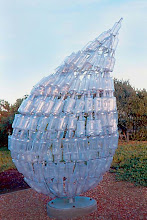
Keith Barrett’s “Whalsay” (2001)

In 2001, Keith Barrett designed a wooden structure to be placed on the island of Whalsay in Shetland, Scotland. This structure really draws from its surroundings, especially the water visible in the distance. From certain angles, the structure appears like a shell sticking out of the ground. Other views of the structure suggest boats turned on their sides. Without the sea nearby, it is doubtful that the viewers would be able to make the connection between the shape of the structure and its meaning. For those who dare to enter in between the two sides of the structure, it also serves as shelter from the high winds. From all these different interpretations of the structure, it is easy to see how its surroundings really play into how it is viewed, interpreted, and understood.
Barrett accurately stresses the importance of each element for the success of the piece, saying: "It is only complete in the relationship between the work, its environment and the viewer. Remove one element of this relationship from the equation and the art loses its meaning. The environment of the work is as much a part of the artwork as the built elements. The person who sees the work and engages with it completes the whole."
Subscribe to:
Posts (Atom)